

At some point, almost every small business needs outside funding. Whether you’re launching a new venture, buying equipment, covering a cash flow gap, or financing growth, a small business loan is one of the most common financing tools used by entrepreneurs and business owners across the United States.
In this guide, we break down — in plain, jargon-free language — what a small business loan actually is, how the process works step by step, the different types available, and what you need to know before applying, so you can make an informed decision about financing your business.
What Is a Small Business Loan?
A small business loan is a sum of money a financial institution (a bank, an online lender, or a government-backed program like the SBA) lends to a business, with an agreement to repay it over a set period of time, plus interest.
Unlike other financing tools such as a business line of credit, a term loan has three defining characteristics:
- It’s disbursed in a single lump sum (you can’t draw down funds gradually as needed).
- It has a fixed repayment term, typically ranging from 1 to 25 years, depending on the loan type and its purpose.
- It’s repaid through periodic payments (usually monthly), covering both principal and interest.
This type of financing is designed for specific, planned needs: purchasing commercial real estate, upgrading equipment, funding an expansion, or covering a startup investment that is expected to generate revenue down the line.
💡 Key takeaway: A term loan is not the same as a business line of credit. If your need is to cover short-term cash flow gaps or recurring unexpected expenses, you may be better served by a [business line of credit], which works differently and offers more flexibility.
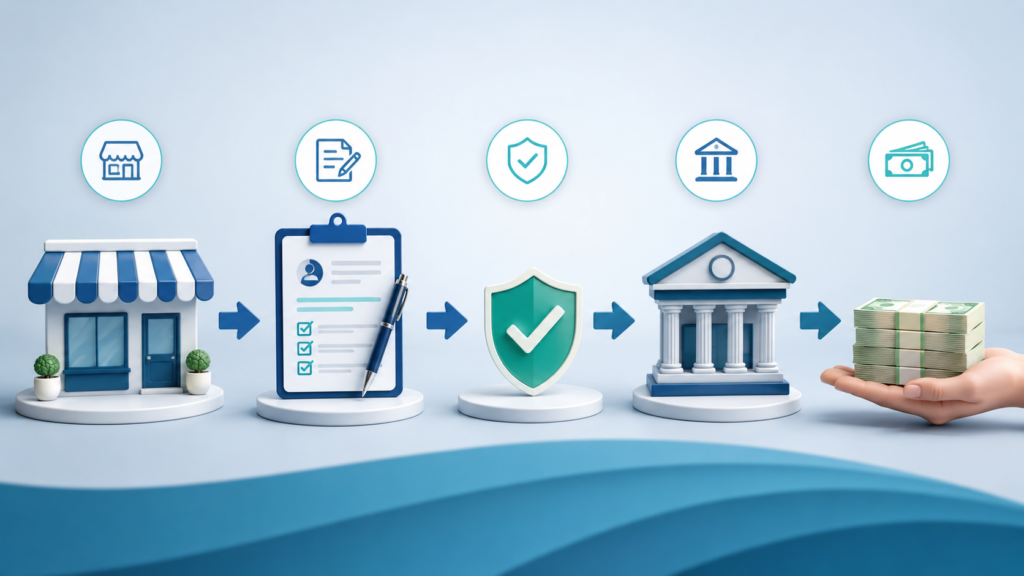
How Does a Small Business Loan Work, Step by Step?
The process of getting a small business loan generally follows this sequence, whether you’re working with a bank, a credit union, or an online lender:
1. Application
The business submits an application to the lender, specifying the amount needed, the purpose of the loan, and the required documentation (detailed below).
2. Underwriting (Risk Assessment)
The lender evaluates the creditworthiness of the business: revenue, time in business, personal and business credit scores, existing debt load, and repayment capacity. This process is called underwriting, and it determines whether the loan is approved, denied, or approved with different terms than requested.
3. Offer and Negotiation of Terms
If the underwriting is favorable, the lender presents an offer that includes the approved amount, interest rate (APR), repayment term, and any required collateral or personal guarantee. In many cases these terms are negotiable, especially for businesses with strong financials or those comparing multiple lender offers.
4. Signing and Funding
Once the terms are accepted, the loan agreement is signed and the lender disburses the full loan amount, typically via direct deposit into the business bank account. Online lenders can often fund a loan within 24 to 72 hours; traditional banks and SBA loans usually take several weeks.
5. Repayment Through Installments
From that point on, the business repays the loan through periodic installments (usually monthly) that include both principal and interest, based on the agreed amortization schedule.
Types of Small Business Loans in the U.S.
Not all small business loans are the same. Here are the most common types you’ll encounter when researching financing options:
- Traditional bank term loans: offered by national and regional banks (e.g., Bank of America, Chase, Wells Fargo). They tend to have lower interest rates but a slower, more document-intensive approval process.
- SBA loans: loans partially guaranteed by the U.S. Small Business Administration and issued through approved lenders. The most popular program is the SBA 7(a) loan, used for working capital, equipment, and real estate, alongside the SBA 504 loan (for major fixed assets) and SBA microloans (up to $50,000). SBA loans typically offer longer terms and lower down payments, in exchange for more paperwork and longer processing times. You can learn more in our dedicated guide on [SBA loans for small businesses].
- Online/alternative lender term loans: from fintech lenders such as OnDeck, Fundbox, or BlueVine. These offer much faster approval (sometimes same-day or next-day funding), though usually at higher interest rates than traditional banks.
- Merchant cash advances (MCAs): technically not a loan, but an advance against future sales, repaid through a percentage of daily credit card or debit sales. Fast but typically the most expensive option.
- Microloans: smaller loans (usually up to $50,000), aimed at startups and very small businesses that don’t yet qualify for traditional bank financing, often issued through nonprofit and community lenders.
Each of these options has different pros and cons depending on how much funding you need, how quickly you need it, and your business’s current financial profile.
What Do Lenders Typically Require to Approve a Small Business Loan?
While requirements vary by lender, most small business loans in the U.S. require:
- Business documentation: EIN (Employer Identification Number), business license, articles of incorporation or organization, and proof of business ownership.
- Financial documentation: business tax returns (usually the last 2–3 years), profit and loss statements, balance sheets, and bank statements (typically the last 3–12 months).
- A business plan: especially for larger loans or newer businesses, outlining how the funds will be used and how the business will generate revenue to repay the loan.
- Credit history: lenders will check both the personal credit score (FICO) of the business owner(s) — usually requiring a minimum of 600–680 depending on the lender — and, in many cases, the business credit score through agencies like Dun & Bradstreet, Experian Business, or Equifax Business.
- Collateral or personal guarantee: depending on the loan amount, lenders may require collateral (equipment, real estate, receivables) or a personal guarantee from the business owner.
If your business is newly established or doesn’t meet all of these requirements, don’t worry — there are specific alternatives, such as SBA microloans or online lenders with more flexible underwriting criteria. Check out our guide on [small business loans with no collateral required] to explore these options.
Pros and Cons of Taking Out a Small Business Loan
Pros
- Provides access to a significant amount of capital in a single disbursement, ideal for specific investments.
- Interest rates are generally lower than other forms of financing like credit cards or merchant cash advances.
- Fixed monthly payments make it easier to plan and forecast your business finances.
- SBA-backed programs offer particularly favorable terms (lower rates, longer terms) specifically designed to support small businesses.
Cons
- Approval through traditional banks and the SBA can be slow (several weeks to a few months).
- Requires substantial documentation and, often, collateral, which not every business can provide, especially younger companies.
- Creates a fixed repayment obligation regardless of how the business performs in the short term, unlike more flexible options such as revenue-based financing.
- A denial, late payment, or default can negatively impact both business and personal credit scores going forward, since many small business loans require a personal guarantee.
When Does It Make Sense to Get a Small Business Loan?
As a general rule, a term loan makes sense when the financing need is specific, planned, and expected to generate a clear return: purchasing an asset that will increase production, opening a new location, or funding an expansion with a clear revenue projection.
On the other hand, if your need is to cover short-term cash flow fluctuations or recurring, unpredictable expenses, a business line of credit may be a better fit, since it lets you draw funds only when needed and pay interest solely on the amount used. Our comparison guide, [business line of credit vs. term loan: which one should you choose], breaks down the differences in detail to help you decide.
Frequently Asked Questions About Small Business Loans
How long does it take to get approved for a small business loan? It depends on the lender: traditional banks and SBA loans can take anywhere from 2 to 8 weeks, while many online lenders can approve and fund a loan within 24 to 72 hours.
Can I get a business loan if my company is newly established? Yes, although requirements tend to be stricter. Options like SBA microloans or certain online lenders with more flexible criteria are specifically designed for businesses with limited operating history.
What happens if I can’t make my loan payments? It’s critical to contact your lender as soon as possible to renegotiate terms (payment deferral, extended term) before missing a payment, since default can seriously damage both your business and personal credit.
Is it better to get a loan from a bank or an online lender? There’s no single right answer: banks and SBA loans typically offer lower interest rates but slower, more document-heavy processes; online lenders are faster and more flexible, usually at a higher cost. The best choice depends on how urgently you need funding and your business’s financial profile.
What credit score do I need to qualify for a small business loan? Most traditional lenders look for a personal FICO score of 680 or higher, while many online lenders will consider applicants with scores as low as 600, often at a higher interest rate.
Conclusion
A small business loan is, ultimately, a financing tool designed for specific, planned capital needs, repaid through periodic installments over a fixed term. Before applying, it’s important to compare multiple lenders, fully understand the terms (interest rate, repayment period, required collateral), and evaluate whether a term loan is truly the best financing option for your business’s current situation.
Hi, this is a comment.
To get started with moderating, editing, and deleting comments, please visit the Comments screen in the dashboard.
Commenter avatars come from Gravatar.