
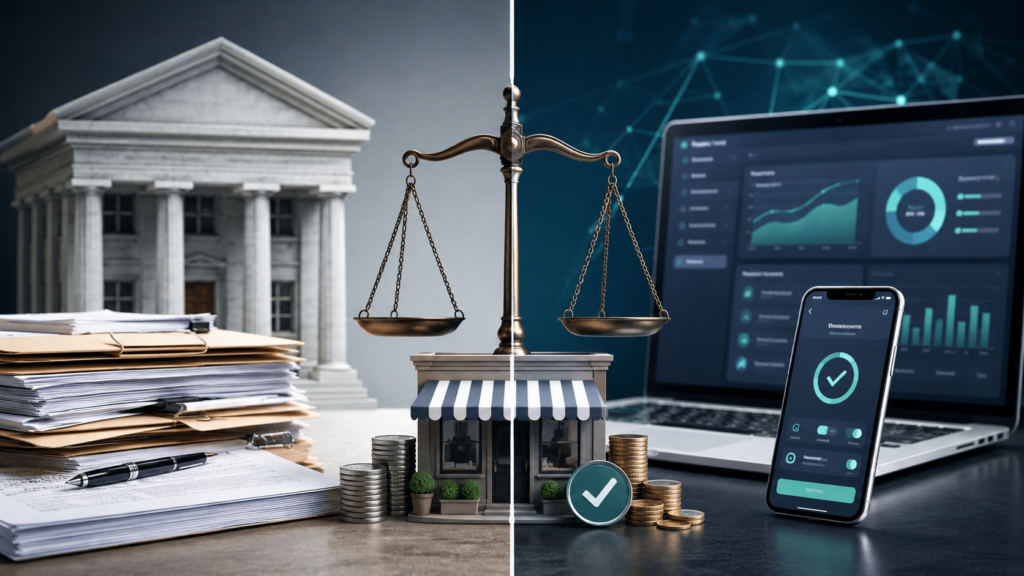
Small business owners today have more financing options than ever — but that also means more decisions. One of the most common questions is whether to apply with a traditional bank or a fintech (online) lender. The honest answer: it depends on what you’re optimizing for — cost, speed, or approval odds. Here’s a direct comparison to help you decide.
The Core Trade-Off
In almost every case, the decision comes down to a simple trade-off:
- Banks: lower cost, slower process, stricter requirements.
- Fintech lenders: higher cost, faster process, more flexible requirements.
Neither is universally “better” — the right choice depends on your business’s current profile and how urgently you need funding.
Approval Odds: Where Are You More Likely to Get a Yes?
Fintech lenders generally have significantly higher approval rates than traditional banks, particularly for:
- Businesses with less than 2 years of operating history
- Owners with personal credit scores below 680
- Businesses without significant collateral to offer
- Businesses needing smaller loan amounts that aren’t cost-effective for banks to underwrite
Traditional banks remain the stronger option for well-established businesses with strong financials, where approval odds are high and the lower cost makes the additional paperwork worthwhile.
Speed: How Fast Can You Actually Get Funded?
| Traditional Bank | Fintech Lender | |
|---|---|---|
| Application time | Hours to days | Minutes to hours |
| Approval decision | 1–6 weeks | Minutes to 72 hours |
| Funding after approval | 1–2 weeks | Same-day to a few days |
If you need funds within a week, a fintech lender is, in nearly all cases, the only realistic path.
Cost: What Will You Actually Pay?
Traditional bank loans and SBA loans consistently offer lower interest rates than fintech alternatives, because banks can rely on lower-cost deposits to fund lending and typically work with lower-risk borrowers. Fintech lenders take on more risk (faster approval, more flexible criteria) and price that risk into higher rates — sometimes structured as factor rates or flat fees rather than a traditional APR, which is worth converting to an effective APR before comparing.
Documentation and Process
- Banks: extensive documentation (tax returns, financial statements, business plan), often requiring in-person or phone conversations with a loan officer.
- Fintech lenders: streamlined online applications, often connecting directly to your business bank account or accounting software instead of requesting manually prepared documents.
For a business owner short on time, the fintech process alone can be worth the added cost.
A Practical Decision Framework
Choose a traditional bank if:
- You’ve been in business 2+ years with strong, consistent financials
- Your personal credit score is 680 or higher
- You can wait several weeks for approval and funding
- Minimizing interest cost is your top priority
Choose a fintech lender if:
- You need funds within days, not weeks
- Your business is newer or has a shorter credit history
- You don’t meet a bank’s stricter underwriting criteria
- You value a fast, largely automated online process over the lowest possible rate
Can You Use Both, Depending on the Situation?
Yes — many established businesses maintain a relationship with a traditional bank for larger, planned financing (equipment purchases, real estate, expansion) while keeping a fintech line of credit or relationship on standby for fast access to cash when timing matters more than cost.
Frequently Asked Questions
Are fintech lenders as safe and legitimate as banks? Reputable fintech lenders are legitimate, regulated financial companies, though the space is less standardized than traditional banking — it’s worth verifying a lender’s licensing and reading reviews before applying.
Will applying to a fintech lender hurt my chances with a bank later? Not directly, though multiple hard credit inquiries in a short period can have a small, temporary impact on your credit score regardless of lender type.
Is it worth applying to both a bank and a fintech lender at the same time? It can be a reasonable strategy if you’re not sure which will approve you, or if you want to compare real offers — just be mindful of the credit inquiry impact of applying broadly.
Conclusion
There’s no universally “easier” option — fintech lenders offer higher approval odds and faster funding, while banks offer lower cost for businesses that qualify and can wait. The right choice depends on how quickly you need capital and how your business’s credit profile currently stacks up. For a closer look at leading fintech options, see our guide on [best fintech financing platforms for small businesses].